
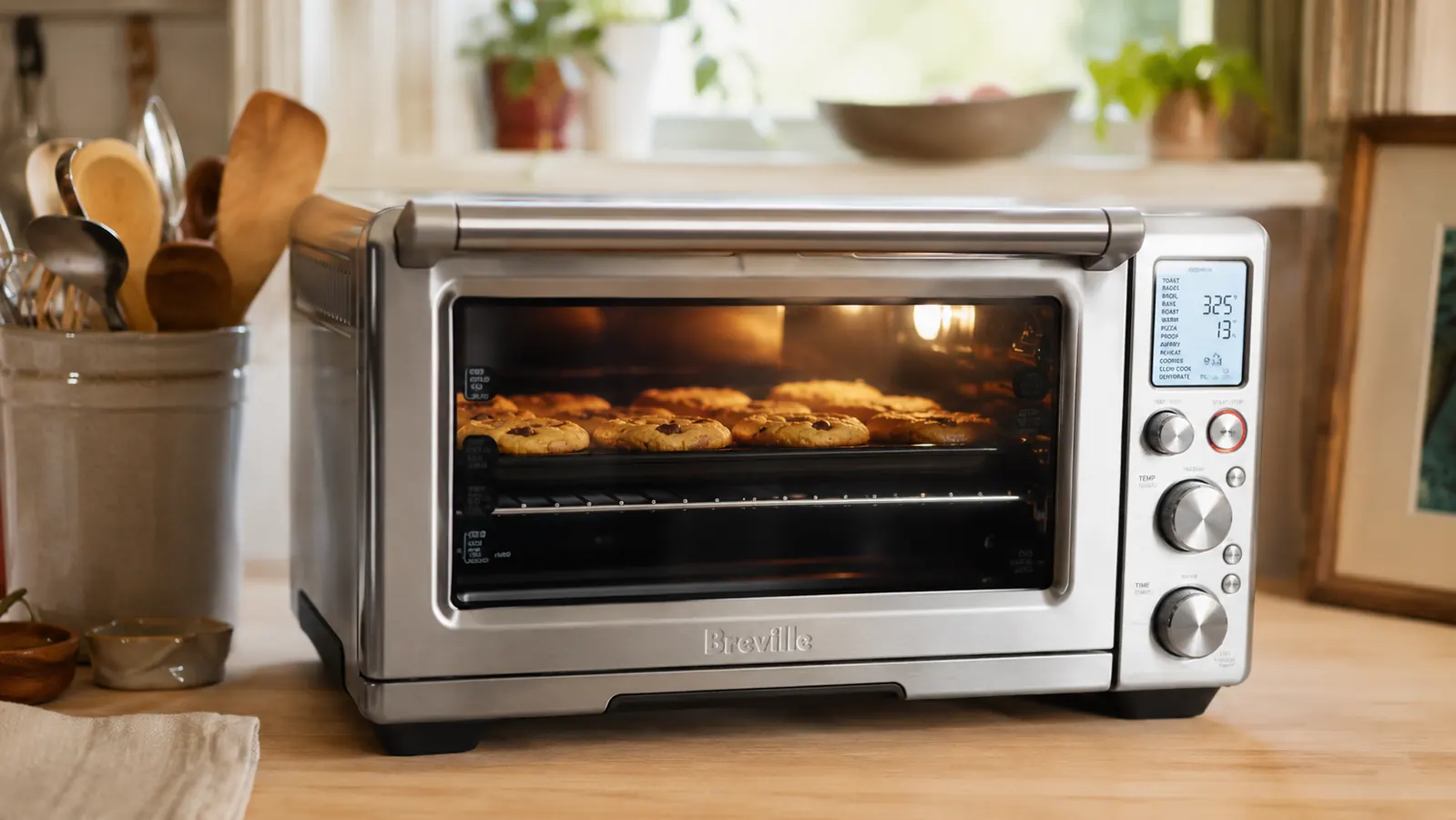
I want to talk about the version of the Breville BOV845 that shows up around month eight. Not the one in the unboxing videos with the perfect rack placement and the first-batch chocolate chip cookies. The one where you've figured out the quirks, developed workarounds you never planned to need, and started quietly wondering if the BOV900 was the smarter buy. That's the oven I'm going to tell you about.
I bake a lot. Sourdough on Saturdays, cookies most weekdays, the occasional layer cake when someone has a birthday. My BOV845 gets used more than my full-size oven, which tells you something about how often I trust it. But trust and love aren't the same thing, and after more than a year of daily baking in this thing, there are real limitations I wish I'd known before I bought it. Nobody warned me about the heating element geometry. Nobody mentioned the crumb tray situation. And almost no review I read prepared me for the capacity ceiling that eventually bites every serious baker.
The Quick Verdict
A genuinely capable countertop oven that bakes better than most, but it asks more of you than the marketing admits. The hot spots are real, the crumb tray is genuinely annoying, and the interior is smaller than you think when you're mid-recipe.
Amazon Check Today's Price →Before the first batch burns, read this: what the BOV845 actually does to your edge cookies.
The Breville BOV845 Smart Oven Pro has 4.6 stars from over 11,000 buyers. Most of them are right. But a few things nobody mentions are worth knowing before you check out.
Amazon Check Today's Price on Amazon →How I've Used It (So You Know Where This Is Coming From)
I run the BOV845 at my home in Charlotte, on a granite countertop in a kitchen that gets used hard. My baking week typically includes at least one loaf of bread, two or three batches of cookies, and occasional sheet pan dinners when I don't want to heat up the house. I've baked with the convection fan on and off, tested rack positions more times than I can count, and burned through two full rolls of parchment paper experimenting with shielding techniques to manage edge browning.
I also have the original Breville manual, the accessory rack set, and I've read every owner forum thread I could find about this oven. So when I say something isn't working the way Breville implies it will, I'm not skipping steps. I've done the troubleshooting. Some things just are what they are.
The Heating Element Problem Nobody Mentions Up Front
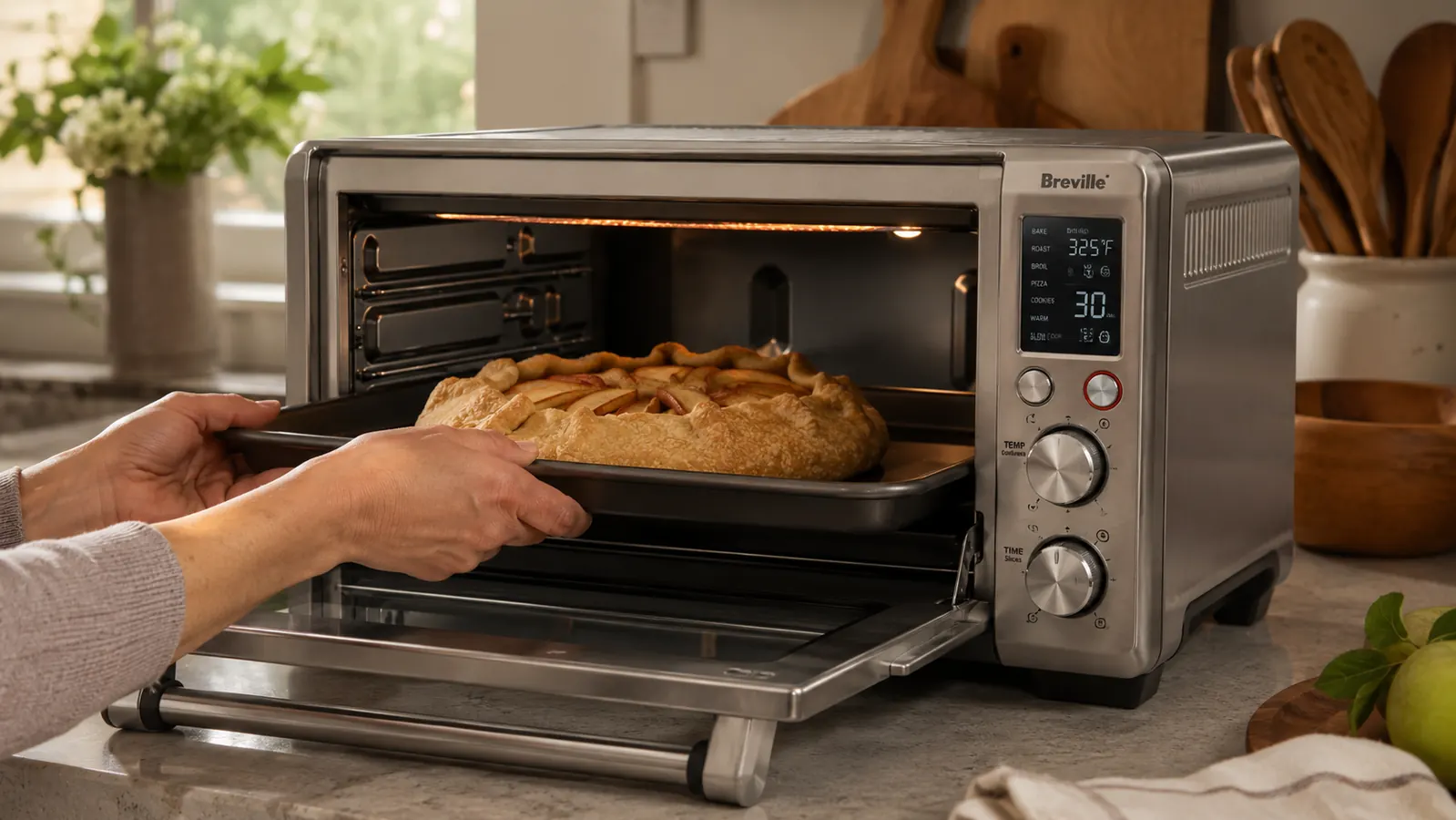
The BOV845 uses five heating elements. Breville calls this Element IQ, and it does genuinely adjust which elements run depending on the cooking function you select. The problem isn't that it doesn't work. The problem is the geometry of those elements relative to your food.
In a full-size oven, you're typically 10 to 12 inches from the top element when you use a middle rack. In the BOV845, on the middle rack position, your food sits roughly 4 to 5 inches from the top elements. That proximity makes the top elements run hotter relative to your food than you'd expect based on the set temperature. The result is this: the tops of your cookies, muffins, and cakes brown faster than the bottoms. Not burned, usually. But browner than you want, and earlier than the recipe assumes.
The workaround most experienced BOV845 owners land on is using the lowest rack position for most baking and dropping the temperature by 15 to 25 degrees from whatever the recipe calls for. It works. But it's a calibration step you have to learn by burning a batch or two first, and it's an adjustment no product description warns you about.
The BOV845 bakes well once you learn its rules. The frustrating part is that it doesn't tell you the rules exist until after your first scorched batch of banana muffins.
Hot Spots: Where They Are and How Bad They Actually Are
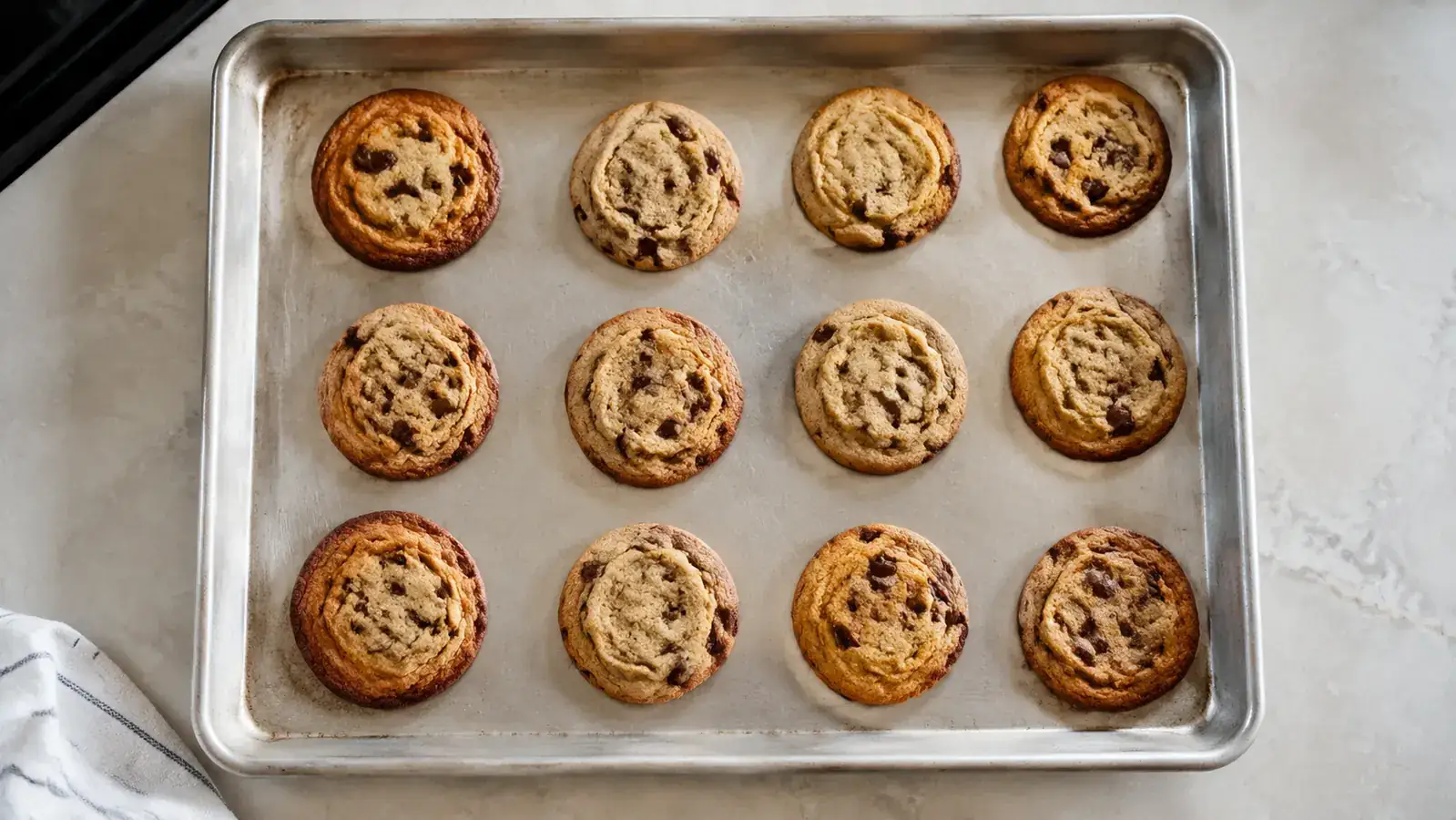
Every oven has hot spots. Your full-size range does too. The question isn't whether they exist; it's whether the convection fan evens things out enough to matter. In the BOV845, the convection fan helps substantially but doesn't eliminate the issue entirely. My consistent experience: the back-right corner runs 8 to 12 degrees hotter than the center. The front-left corner runs slightly cooler.
For a dozen standard-size cookies on a half-sheet pan, this means the back-right cookies finish about 90 seconds ahead of the front-left. On a 12-minute bake, that gap is meaningful. My solution is a pan rotation at the 7-minute mark, which I've built into muscle memory at this point. But I want to name this clearly: a premium oven that markets precision temperature control should be more consistent across its baking surface than this one is.
Convection mode (the fan-assisted setting) tightens the gap considerably. If you forget to use it, or if you're baking something that doesn't do well in a convection environment, like certain delicate pastry doughs that puff unevenly in moving air, you'll feel the hot spot more. For bread, I use the non-convection setting and account for the rotation. For cookies, convection with a midpoint rotation is the move.
The Capacity Ceiling: Smaller Than It Looks
The BOV845 fits a 13 by 9 baking pan, which sounds like plenty. And it is, until you try to bake a full batch of roll-out sugar cookies, fit two loaf pans side by side, or slide in a standard half-sheet pan. The stated interior is 13 by 13 inches, but the usable flat baking area accounting for rack edges and the crumb tray lip is more like 12 by 11.5 inches. Your 13 by 9 fits, barely, with maybe a quarter inch of clearance on the sides.
Where this actually bites me: double batches. I bake for my family of five, and most recipes I use are scaled for two dozen cookies or two loaves. In the BOV845, I do one sheet at a time. Always. The oven's interior doesn't allow stacking two racks of cookies at once with enough clearance for proper air circulation, especially on convection. If you bake in single batches and your recipes are sized accordingly, this isn't a problem. If you batch-bake regularly, you'll feel the limitation every single session.
I've seen a lot of reviewers compare the BOV845 to a standard toaster oven and conclude it's enormous. Compared to a 4-slice toaster oven, yes. Compared to a full-size oven, it's a meaningful compromise. Know which comparison is relevant to how you actually bake.
The Crumb Tray: My Least Favorite Thing About This Oven
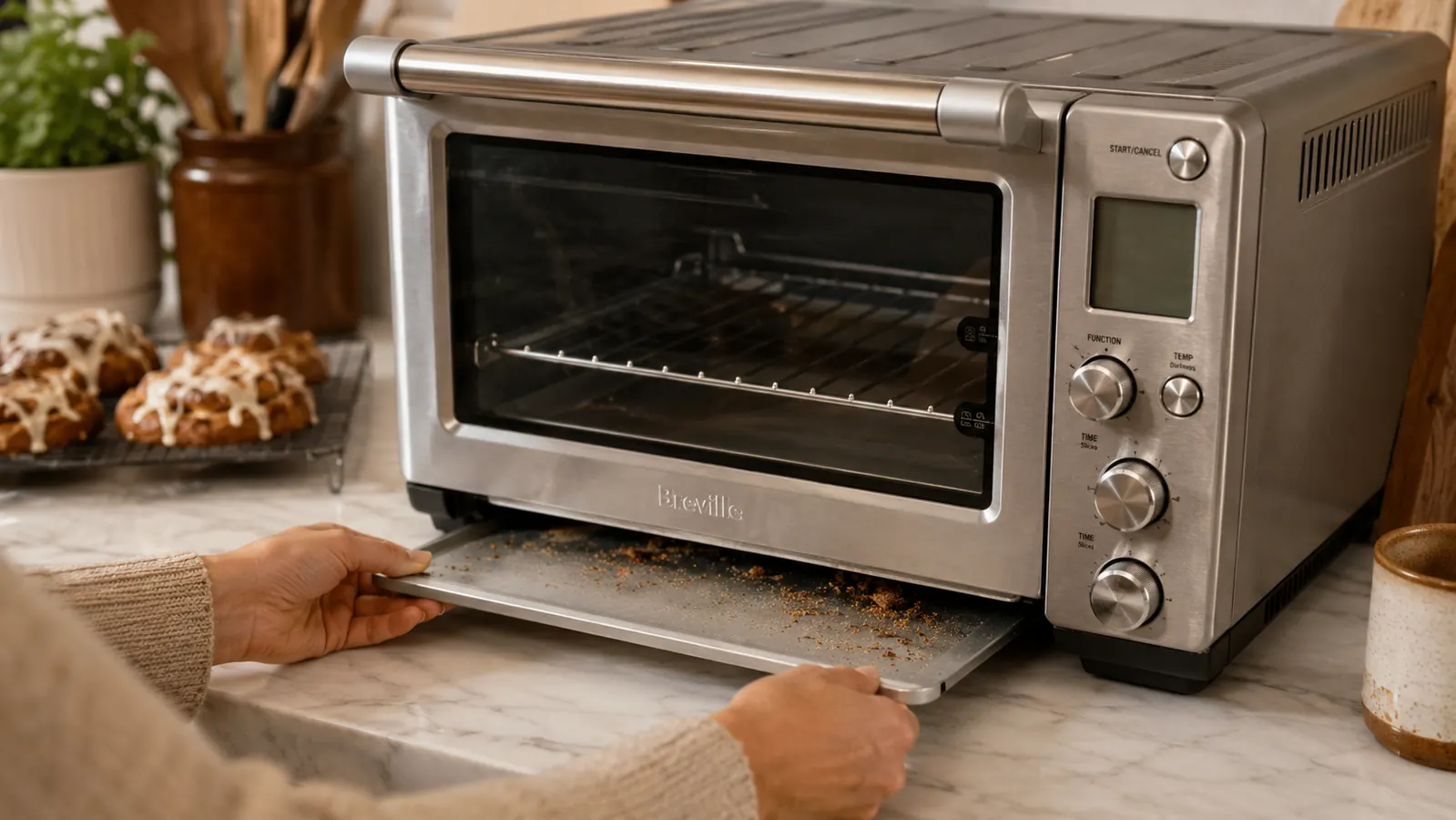
I want to spend a moment on the crumb tray because I feel strongly about it. The BOV845's crumb tray slides out from the bottom front of the oven. It's positioned under the interior floor, which means you can't clean it by tilting the oven or lifting it out from above. You slide it out toward you from a slit at the bottom front edge of the unit.
The problem is threefold. First, the tray doesn't extend the full depth of the oven, so debris that falls toward the back doesn't land on the tray and can't be swept onto it from the accessible front edge. Second, the slit the tray slides through is narrow enough that anything with a raised edge, like a crust fragment or a seed, gets hung up. Third, the tray itself is thin, uncoated stainless that shows grease and baking residue in a way that always looks worse than it probably is. After baking anything with oil or butter, I feel like I need to pull it and wipe it every session or it starts to smell.
For everyday baking, the cleanup routine is: pull the crumb tray, dump it over the trash, wipe with a damp cloth, replace. About 90 seconds. But the debris that falls behind the tray toward the back of the oven floor is a problem I have no good answer for other than turning the oven upside down over the sink, which I do about once a month and which is as awkward as it sounds. This is a design compromise I accept. But I accept it annoyed.
What I Liked
- Element IQ genuinely adjusts heat distribution for different cooking modes, and it's noticeably smarter than a dumb toaster oven
- Convection fan is effective and quiet, with minimal fan noise during baking cycles
- Temperature accuracy is solid when you dial in the 15-20 degree adjustment for countertop proximity
- The backlit LCD and intuitive knob interface are a pleasure to use after years of dial-only toaster ovens
- Interior light stays on during baking so you can actually monitor browning without opening the door
- Brushed stainless steel exterior holds up well and cleans easily with a damp cloth
Where It Falls Short
- Hot spot in the back-right corner requires a mid-bake pan rotation to get even browning on cookies and pastries
- Heating elements run close to your food on the middle rack, so tops brown faster than most recipes assume
- Interior baking area is smaller in practice than the 13x13 spec implies when you account for rack and tray edges
- Crumb tray doesn't cover the full oven floor, so rear debris accumulates where you can't easily reach it
- No interior volume measurement anywhere in the specs, so comparing to other ovens requires hands-on testing
- Single-rack baking only for most applications, which means batch bakers are doing two runs where a full-size oven does one
Temperature Accuracy: Better Than You'd Expect, With One Catch
I tested the BOV845 with an oven thermometer in three positions: center rack center, center rack back-right, and center rack front-left. At a set temperature of 350 degrees, center-center read 347, back-right read 358, front-left read 339. That's a 19-degree spread across the baking surface. Not unusual for a countertop oven, but meaningful if you're baking something where 20 degrees makes a real difference, like macarons or choux.
For most everyday baking, bread, cookies, sheet pan vegetables, roasted chicken thighs, the accuracy is more than sufficient. The oven holds set temperature reliably once it's preheated, and the Element IQ system does a better job of recovering after a door-open event than cheaper countertop ovens I've tested. The smart move is to run it for 15 minutes of preheat on convection before you load the first pan. Most recipes assume 10. Give it the extra five minutes and you'll get more consistent results.
The Honest Case for Upgrading to the BOV900
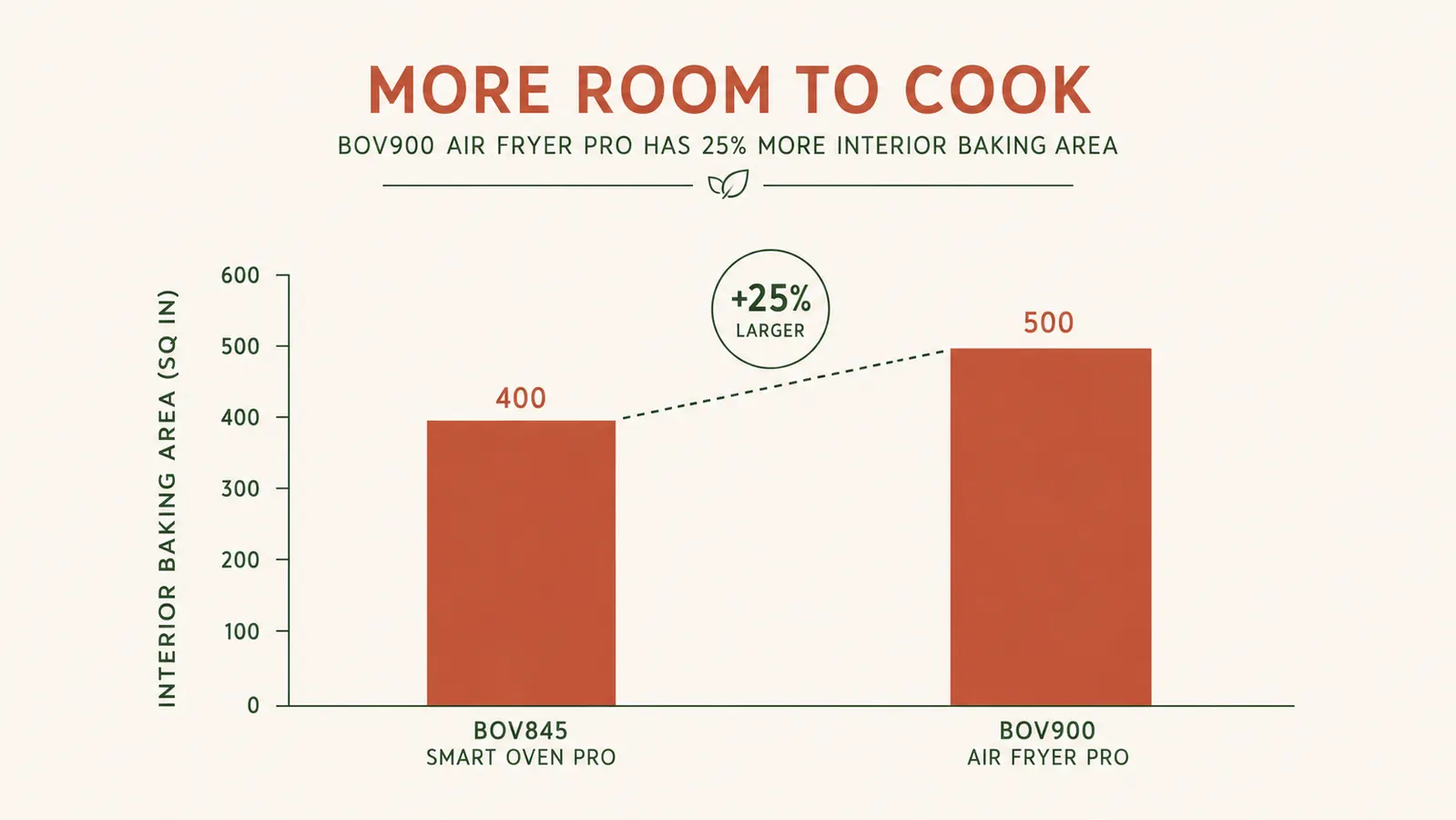
Here's the question I get asked most often: should you just buy the BOV900 instead? It depends entirely on what you're giving up. The BOV900 is larger, adds a super convection mode with a more powerful fan, and has an air fry function the BOV845 doesn't. It also costs moderately more at any given time.
If your primary frustration with countertop ovens is capacity, the BOV900 is the answer. Its interior is meaningfully larger, which gets you closer to genuine two-rack baking. If your frustration is hot spots and uneven browning, the BOV900's super convection mode helps but doesn't fully solve the problem, because the geometry issues are inherent to the countertop form factor. If you never air fry, you're paying for a feature that doesn't move the needle for you.
My honest take: the BOV845 is the right buy for a baker who wants better-than-standard performance in a countertop oven and doesn't need the air fry function. The BOV900 is the right buy for someone who wants to replace their full-size oven for a wider range of tasks, or who genuinely batch-bakes and needs the extra interior space. Both are good. Pick based on your actual use case, not on which one has more features listed in the spec sheet.
Who Should Buy the BOV845
You're the right buyer for the BOV845 if you bake single-batch recipes, do most of your work in the 8-inch to 13-inch pan size range, and care more about precise temperature control than about sheer interior volume. You're also the right buyer if you've been frustrated by cheaper countertop ovens that lose heat quickly, cycle unevenly, or don't give you any feedback on actual temperature versus set temperature. The BOV845 is genuinely better than most of the market in these areas.
You're also a good fit if you bake things that benefit from close, intense top heat: broiling, toasting, melting cheese. The same heating element proximity that creates challenges for delicate baked goods is an advantage for tasks where you want surface browning fast. The BOV845 makes exceptional toast, for what it's worth.
Who Should Skip It
Skip the BOV845 if you regularly bake full double batches and want to run two racks simultaneously. The interior just isn't there, and trying to force two racks of cookies into this oven produces inconsistent results that will frustrate you. Also skip it if you have a genuine need for air frying, because the BOV900 adds that function without costing dramatically more. And skip it if you want to bake full 18 by 13 half-sheet pans, because they simply don't fit.
The BOV845 is not a toaster oven upgrade. It's a real baking appliance with real limitations. Anyone telling you it fully replaces a full-size oven for a serious home baker is oversimplifying. It does specific things very well. Know what those things are before you buy.
If the BOV845 is your size, here's where to check today's price before you decide.
The Breville BOV845 Smart Oven Pro currently holds a 4.6-star rating from more than 11,000 Amazon buyers. It earns those stars for the things it does well. Check the current price and availability before you make the call.
Amazon Check Today's Price on Amazon →