
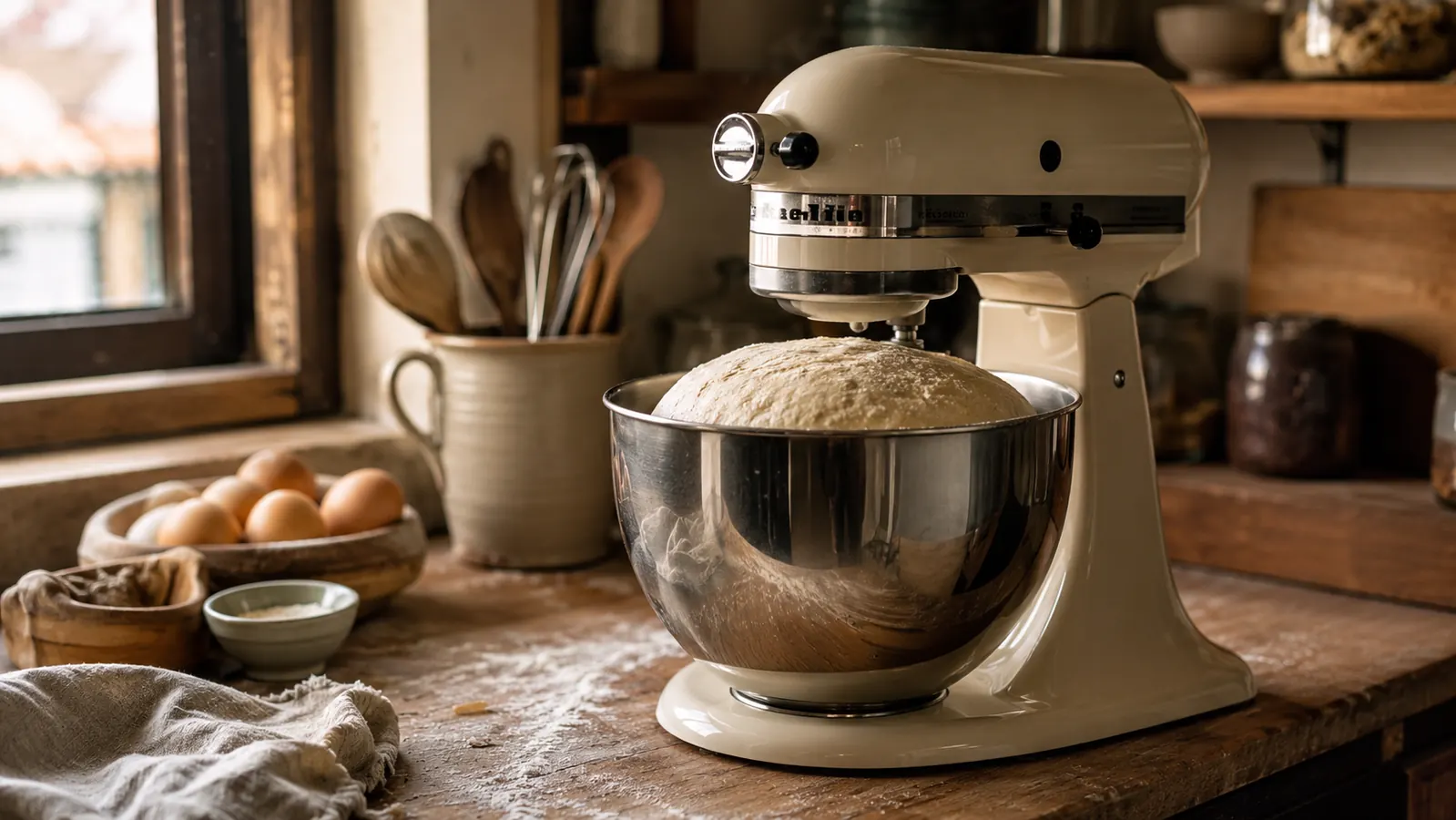
Three years ago I finally stopped fighting my hand mixer and bought the KitchenAid Artisan 5-quart. My Saturday baking schedule had outgrown everything I had tried before. Two Cuisinart hand mixers burned out on me in four years, one during a double batch of bagel dough that was, admittedly, probably too stiff for anything with a cord. I needed something that would not flinch at whole-wheat bread dough, weekly pizza batches, and the occasional seven-minute frosting. The Artisan was the machine everyone said to buy. After three years and well over 150 baking sessions, I can tell you exactly what they were right about and where they oversell it.
I bake every Saturday, sometimes Sunday too. Typical output: one to two loaves of bread or a batch of dinner rolls, plus whatever dessert project I am into that month. I have pushed this mixer through stiff brioche dough, double batches of oatmeal cookies, several rounds of royal icing for holiday cookies, and more pizza dough than I can count. I am not gentle with it. This review reflects that.
The Quick Verdict
The KitchenAid Artisan is the right mixer for the serious home baker who bakes weekly and wants a machine that will still be on the counter in a decade. It earns its price. Just know its limits before you buy.
Amazon Check Today's Price →If you bake more than twice a month, stop renting cheap mixers that burn out on you.
The KitchenAid Artisan has a 4.7-star rating from over 22,000 buyers and has been the benchmark home stand mixer for years. Check today's price and color options on Amazon.
Amazon Check Today's Price on Amazon →How I Have Used It: Three Years of Real Baking
My Artisan lives on my kitchen counter full-time. It is not a cabinet appliance. I use it at least once a week, and during the holidays I can run it four or five times in a week. The first thing I learned is that the tilt-head design is genuinely convenient when you are adding flour cup by cup and need to scrape the bowl constantly. You flip the head back, scrape, lock it down, and go. After three years that hinge is still snug, no wobble.
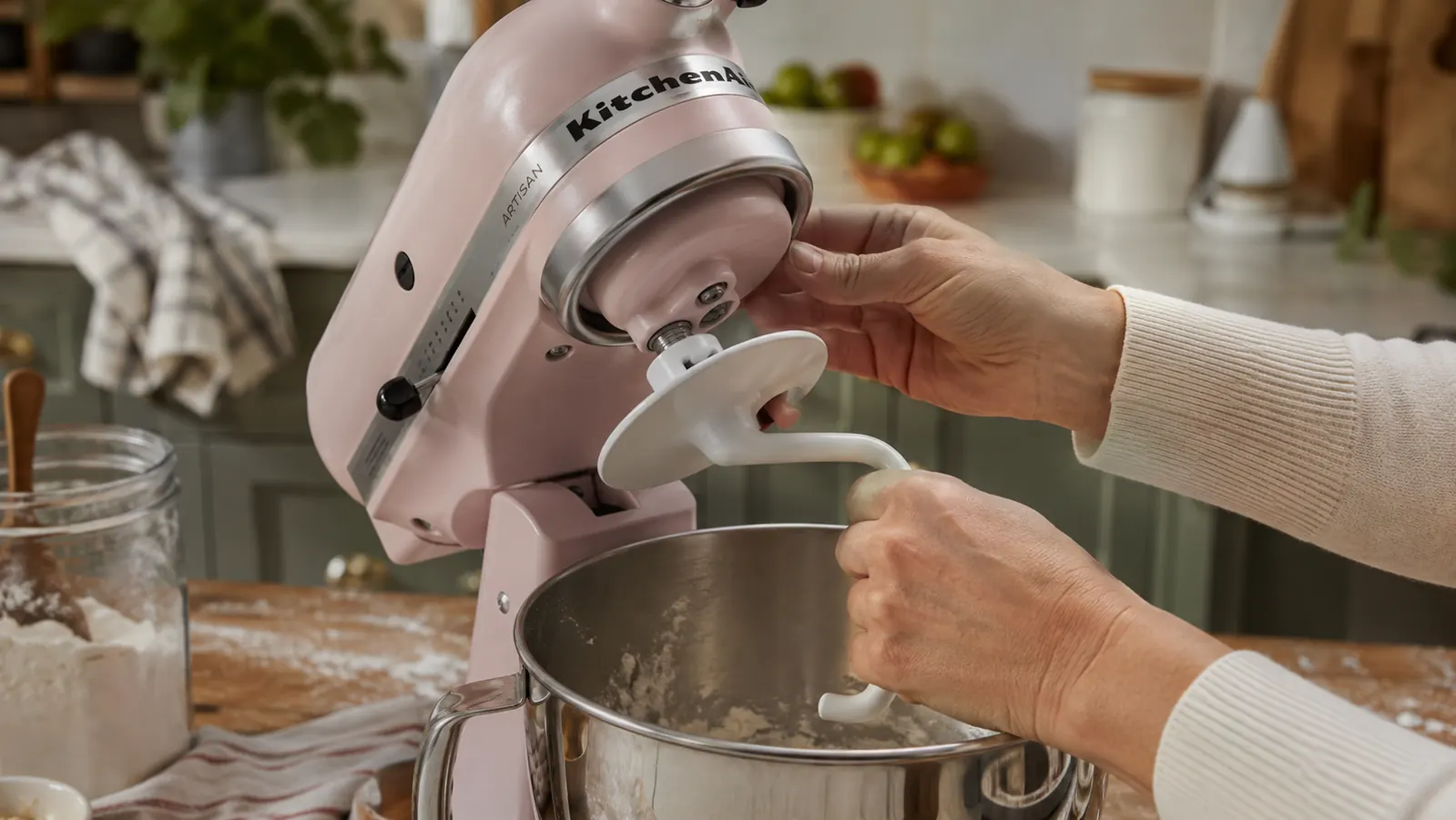
My go-to recipe for testing any mixer is a double batch of whole-wheat sandwich bread. The dough is tight and heavy, and it will tell you everything you need to know about a motor within about six minutes of kneading. The Artisan handles a single batch on speed 2 without complaint. A double batch (roughly 3 lbs of dough) is where I start to pay attention. The motor gets warm, and the mixer will walk across the counter if the dough is stiff enough. I use a non-slip mat under it now, which helps. I have never had it shut off on thermal protection mid-knead, but I keep batches to the 5-quart bowl limit and do not push it much past that.
The included attachments are solid. The flat beater handles cookie dough, cake batters, and mashed potatoes without issue. The dough hook does the kneading I described above. The wire whip makes excellent meringue. I added the pasta roller attachment in year two and it has been one of the best kitchen purchases I have made. The attachment port has not loosened up at all, which I was honestly a little worried about.
Motor and Build: What Actually Holds Up After Heavy Use
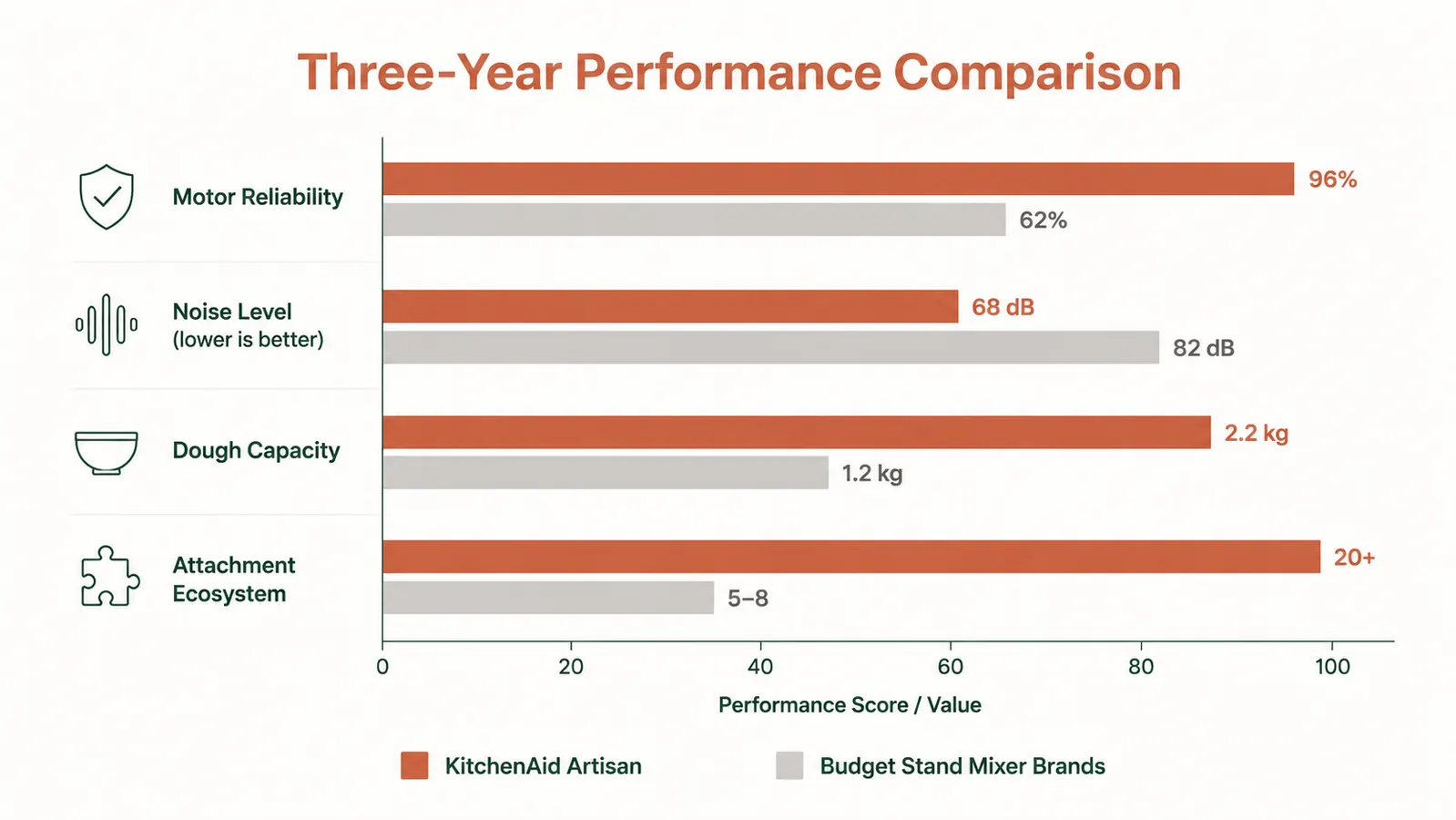
The 325-watt motor in the Artisan is honestly the one thing I want to be upfront about. It is adequate for most home baking, but it is not unlimited. On very stiff doughs like bagels or pretzels, you will hear the motor working. Do not run it past speed 2 on a full bowl of dense dough. The machine will slow down noticeably if you do, and while I have not damaged mine, I have read enough about burned-out motors to take the warnings seriously.
The planetary mixing action, where the attachment spins on its own axis while orbiting the bowl, is the real engineering advantage here. It reaches nearly every part of the bowl without you moving anything. After three years I have never had a pocket of unmixed flour at the bottom of the bowl on anything other than a very stiff dough that needed a manual scrape anyway. The bowl itself is stainless steel and has taken a beating. I have dropped the beater into it, scraped it with metal spoons by accident, and run it through the dishwasher hundreds of times. No issues.
The exterior is coated cast metal. On my Contour Silver finish, I have not seen any chipping. I have heard from bakers with lighter colors, like Empire Red and Majestic Yellow, that the finish is more forgiving to keep clean than it is to keep chip-free if you set the head down hard. My advice: be a little deliberate when you lower the head back down, and keep citrus-based cleaners away from the exterior. The machine is heavy at about 26 pounds, which means it does not slide when you set the bowl, but it also means you are not moving it around much.
After three years and over 150 baking sessions, the tilt-head hinge is still snug and the attachment port has not loosened. That is what I needed to know before I spent the money, and that is what I am telling you now.
Performance on Different Doughs and Batters
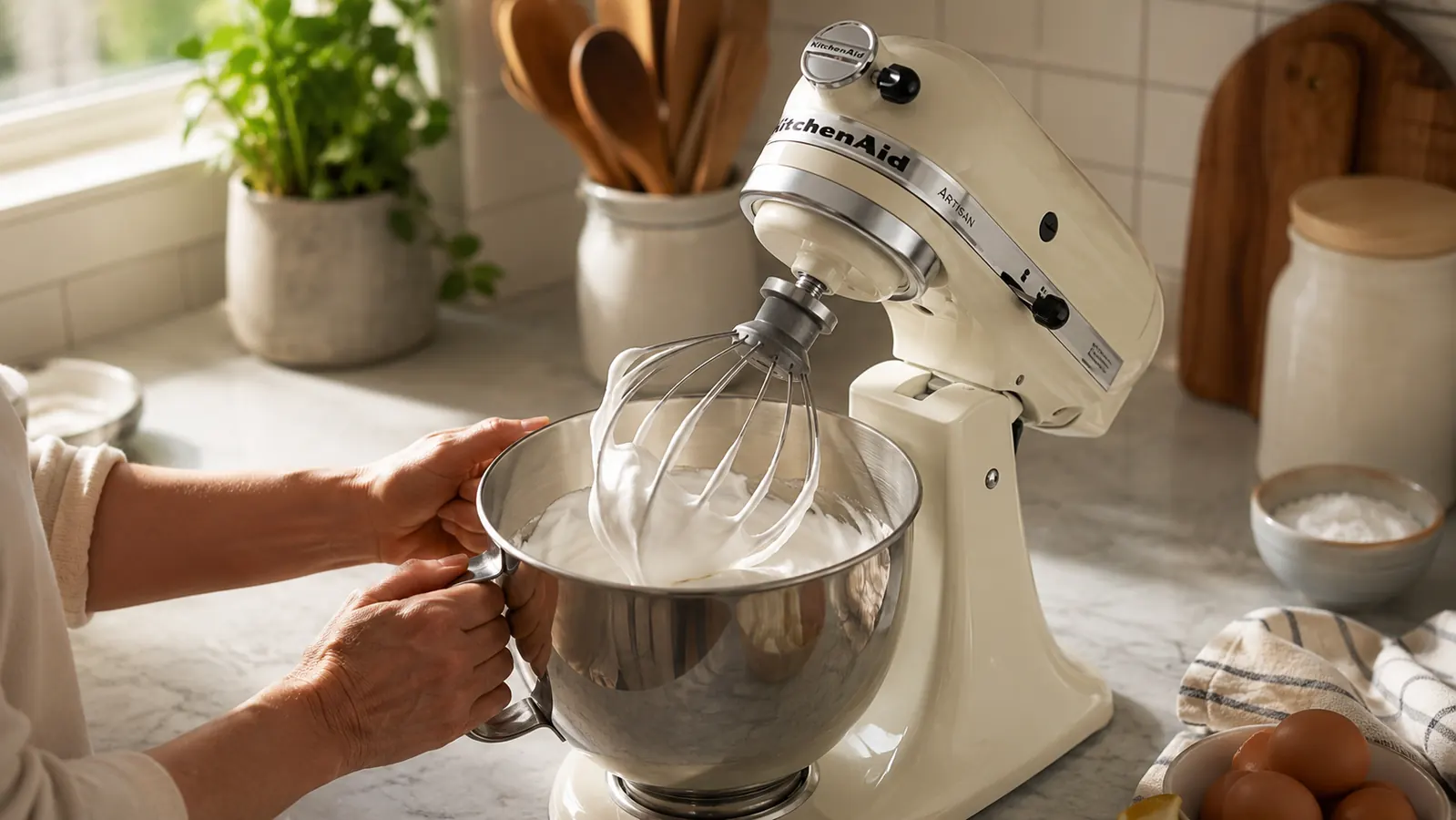
Cookie dough and cake batter are where this machine shines with zero caveats. I can dump two sticks of cold butter, cut into cubes, into the bowl with sugar and let it run on speed 4 until it is light and fluffy. No babysitting. The flat beater does a better job of creaming butter than I could do by hand in half the time. For delicate applications like whipping cream or making Swiss meringue buttercream, the wire whip is precise. I can hit stiff peaks on egg whites reliably on speed 10 in about three minutes.
Bread dough requires more attention. I knead most yeasted doughs for 8 to 10 minutes on speed 2. The dough hook works well on lean doughs (flour, water, salt, yeast) and enriched doughs up to a moderate hydration. Where I notice the limits is on very high-hydration sourdoughs, which I do in the mixer to get them started and then finish by hand. The mixer at that hydration wants to slosh, not knead, until the dough firms up a bit. If you are a serious sourdough baker running 78 percent or higher hydration doughs regularly, the Artisan will feel awkward. If you are making sandwich bread, pizza dough, and dinner rolls like I am, it is more than capable.
Noise is real. The Artisan on speed 2 kneading dough is noticeably loud in an open kitchen. On speed 10 whipping egg whites, it is quite loud. My family has learned not to have a conversation in the kitchen when the mixer is running. This is not unusual for this class of machine, but it is worth knowing if you share a small apartment or bake early in the morning.

Alternatives I Considered and Why I Still Choose the Artisan
Before I bought this mixer, I looked hard at the Cuisinart SM-50 and the Bosch Compact. The Cuisinart is cheaper by a significant margin and has a larger 5.5-quart bowl. I have used one at a friend's house. It is a good machine and the value case is real. What pushed me to the Artisan was the attachment ecosystem. KitchenAid has over a dozen first-party attachments, and I knew I wanted the pasta roller eventually. The Cuisinart has a much smaller third-party attachment market. If you just need a mixer and nothing else, the price gap matters. If you want the machine to grow with you, KitchenAid's system is unmatched.
The Bosch Compact is a serious baker's machine with a more powerful motor, but it costs more, has a less intuitive design, and the attachment selection is narrow. It is better for very heavy doughs, full stop. If you are making exclusively bread and never cookies or cakes, the Bosch is worth a look. For a baker like me who does both, the Artisan is more versatile day-to-day.
One more option worth mentioning: the KitchenAid Professional 5 Plus. It has a bowl-lift design (instead of tilt-head), a more powerful 450-watt motor, and a 5-quart bowl. For frequent bread bakers who push stiff doughs regularly, it is a meaningful upgrade. I have a full comparison on this site if you want to dig into the specifics. See my article on the KitchenAid Artisan vs Professional 5 for a side-by-side breakdown.
What I Liked
- Tilt-head design makes bowl access genuinely convenient for adding ingredients mid-mix
- Planetary mixing action reaches nearly every part of the bowl without manual scraping
- Massive first-party attachment ecosystem (pasta, grain mill, meat grinder, ice cream bowl and more)
- Stainless bowl and housing are built to last, mine looks nearly new after three years
- Handles cookies, cakes, whipped cream, and moderate bread doughs without switching machines
- Over 20 colors available, which matters when it lives on your counter permanently
Where It Falls Short
- 325-watt motor reaches its limit on very stiff or very heavy dough, particularly double batches
- Walks across the counter on dense doughs if you do not use a non-slip mat
- Loud at high speeds, not a quiet background appliance
- At about 26 pounds, it stays where you put it, which means clearing dedicated counter space
- The price is a real commitment, not an impulse buy
Who This Is For
You bake at least once a week. You have been burned by cheap or mid-tier mixers dying on you. You want a machine that handles everything from birthday cake to bread dough without buying two different appliances. You are interested in expanding what you make over time, whether that is homemade pasta, fresh-ground flour, or sausage. You want to buy once and be done. The KitchenAid Artisan was designed for you. It also makes sense as a gift for someone who is a serious baker and does not already own one. The 22,896 reviews at 4.7 stars are not a fluke. This machine converts skeptics.
If you want to understand more about what a stand mixer actually changes in your baking routine, check out my piece on 10 reasons a stand mixer transforms your baking. It walks through the specific tasks where hand mixing just does not compare.
Who Should Skip It
If you bake once a month or less, the price is hard to justify. A good hand mixer handles the occasional batch of cookies without issue. If you bake almost exclusively very stiff or very high-volume bread doughs and nothing else, the KitchenAid Professional 5 Plus or a Bosch will suit you better. If your counter space is genuinely limited and you cannot dedicate a permanent spot to a 26-pound machine, you will find the Artisan annoying to store and retrieve. And if you are trying to find the absolute lowest price per unit of baking output, there are cheaper mixers that will do an acceptable job for a few years before they need replacing.
Three years in, I would buy this mixer again without hesitating.
The KitchenAid Artisan 5-quart is the standard by which other home stand mixers get measured for good reason. If you bake regularly and want a machine that will still be running well in a decade, check the current price on Amazon and pick the color that belongs in your kitchen.
Amazon Check Today's Price on Amazon →